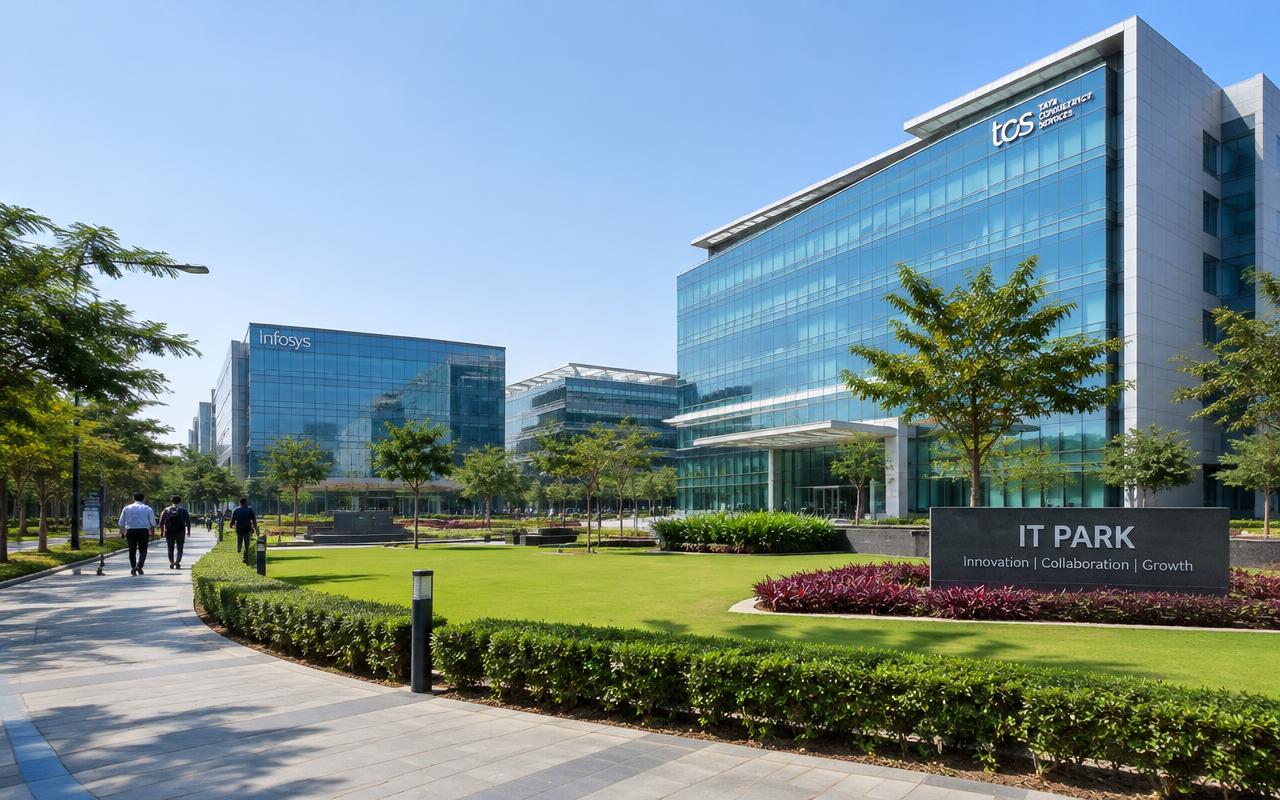
IT Park Land for Data Centres
Plots inside IT parks with ready fibre, approvals and a clean planning record.
What this land type gives you — and what it asks of you
When to choose IT park land — and when not to
IT park plots trade acreage for certainty: the layout is already sanctioned, carriers are already in the ducts, and you are inside the city rather than an hour outside it.
Why teams choose IT park land
- Clean planning record
The park's layout is already sanctioned, so the planning history you inherit is short, documented and easy for lenders to diligence.
- Carriers already present
Multiple operators are usually lit inside the park, often on diverse duct routes — the hardest thing to retrofit on a greenfield plot.
- Close to users and staff
In-city locations give low latency to enterprise customers and a realistic commute for operations and NOC teams.
- IT/ITeS use generally covers data centres
Most state IT and data-centre policies treat a data centre as a permitted IT/ITeS activity inside a designated park.
- Shared infrastructure lowers capex
Power ring, water, roads, perimeter security and amenities are built and maintained by the park.
What to check before you sign
- Little room to grow
Plots are small and neighbours are built out. If phase one fills, expansion usually means a second site rather than more land.
- FSI, setback and height controls
A data hall plus power yard, fuel storage and chiller plant is a demanding footprint. Test it against the approved controls before you bid.
- Association rules bite
Park by-laws can restrict DG stack heights, bulk fuel storage, generator testing hours and night-time acoustic levels.
- Your load is the park's load
Capacity is bounded by the park's own sanctioned load and how much is already allocated to other occupiers.
- Premium pricing
This is the most expensive of the six land types per acre, and water and acoustic constraints are tighter in-city.
Getting IT park land data-centre ready
Six stages, run in parallel wherever the approvals allow it. You get a written position on power and title before any money is committed.
- 01
Park and plot shortlist
We screen parks on sanctioned load, carrier count, duct diversity and how much of the park's capacity is still unallocated.
- 02
Planning and FSI check
Approved layout, FSI, setbacks and height limits are tested against a data-hall-plus-power-yard footprint.
- 03
Carrier and latency mapping
Existing carriers, diverse entry routes and latency to the nearest internet exchange are mapped for the exact plot.
- 04
Park rules review
Association by-laws on DG stacks, fuel storage, generator testing hours and acoustic limits are reviewed before you commit.
- 05
Allotment or transfer
Plot allotment or transfer from the park developer, with expansion, parking and route-entry rights written in.
- 06
Approvals and fit-out
Plan sanction, fire NOC, consents and the connection upgrade, then shell and fit-out.
Rule of thumb: the checklist opposite is what moves IT park land from an interesting parcel to a buildable site. We map the owner, fee and realistic duration of each item before you sign.
Approvals and documents for IT park land
Exact names and sequencing differ by state and local authority. This is the checklist we work through, and the one your lender will expect to see closed out.
- Plot allotment or transfer deed from the park developer
- Approved park layout plus FSI, setback and height confirmation
- Park association by-law clearance for DG, fuel and acoustics
- IT/ITeS permitted-activity confirmation for a data centre
- Building-plan sanction and occupancy certificate
- Fire NOC
- State pollution control board consents, including noise limits
- Load enhancement sanction from the discom via the park
All six land types, side by side
Most briefs end up comparing two or three of these. Your row is highlighted — follow any other link to see that route in the same detail.
| Land type | Typical parcel | Power connection | Approvals | Cost profile | Best for |
|---|---|---|---|---|---|
| Industrial Land | 5–50 acres | 6–12 months (HT/EHV) | Low — already industrial | Moderate, state-benchmarked | Colocation and enterprise builds |
| SEZ Land | 2–25 acres in-zone | 3–9 months | Moderate — zone plus unit approvals | Lease premium plus zone charges | Export-oriented cloud and hosting |
| IT Park LandYou are here | 1–10 acres | 3–9 months | Low — layout pre-sanctioned | Highest per acre | Edge and city-proximate colocation |
| Agricultural Land Conversion | 10–100+ acres | 12–24 months | High — conversion is critical path | Lowest land, highest process | Hyperscale campuses with runway |
| Brownfield Sites | 2–20 acres, built-up | 1–6 months on existing load | Moderate — change of activity | Mid; remediation is the swing | Speed-to-market retrofits |
| Power-Ready Land | 10–60 acres | Fastest at scale — 66/132/220 kV | Low to moderate | Premium for the power position | Large MW blocks, schedule-driven |
Indicative ranges for planning conversations only. Parcel size, connection timeline and approval burden are always confirmed site by site with the relevant authority and utility.
What a deal on IT park land usually needs
The work below is what turns this land type into a buildable site. Engage the whole sequence or just the piece you are missing.
Top cities for it park land
We source and verify this land type across 262+ Indian cities. Start with a market below, or tell us your megawatt and acreage target and we will come back with matching parcels.
IT Park Land: frequently asked questions
In most states an IT/ITeS land use covers data centres, and several state IT and data-centre policies say so explicitly. What varies is the park's own rulebook — DG stacks, fuel storage, generator testing hours and acoustic limits — so we read the approved layout and the association by-laws, not just the state policy.
Tell us your MW, acreage and timeline
We reply within one working day with matching parcels and a clear next step.