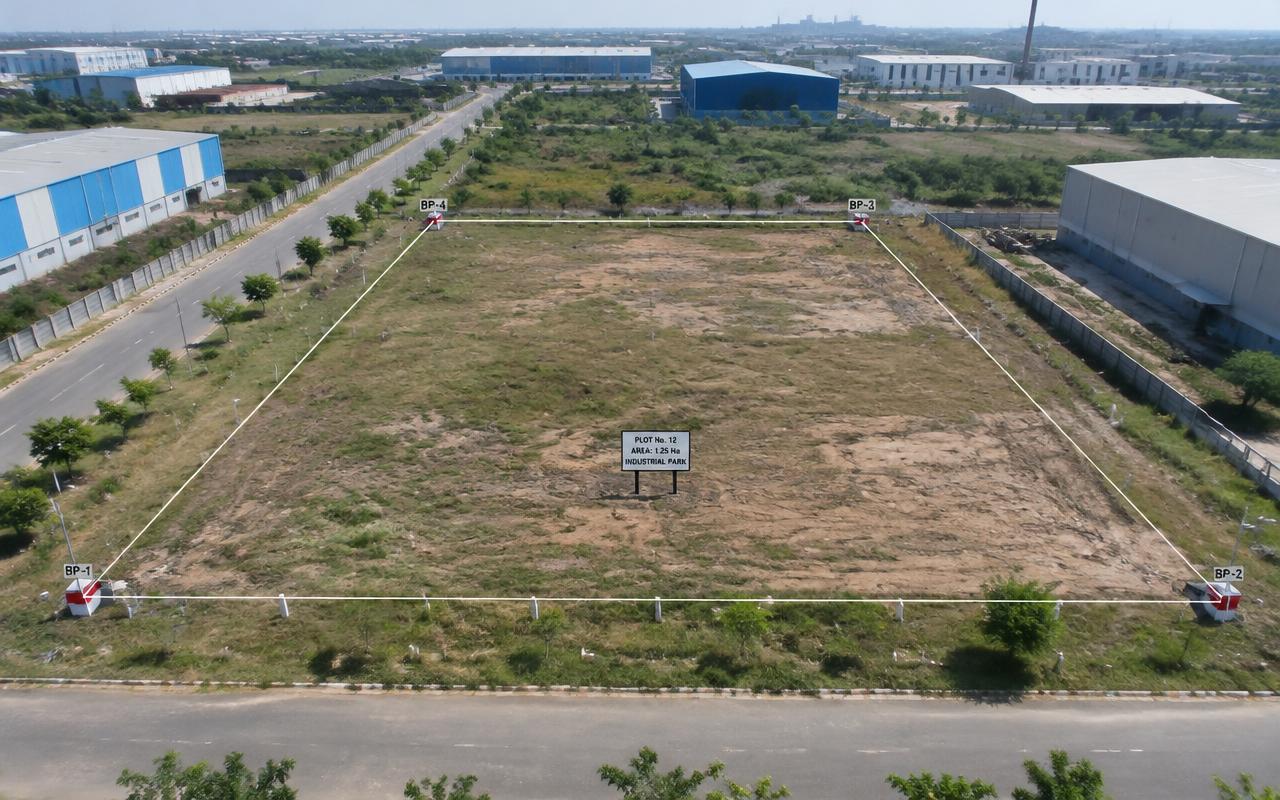
Industrial Land for Data Centres
Notified industrial plots with heavy-load roads and grid access — the fastest path for most data-centre builds.
What this land type gives you — and what it asks of you
When to choose industrial land — and when not to
Notified industrial plots are the default route for most Indian data-centre builds: the land use is already right, the roads take heavy loads, and the grid is close.
Why teams choose industrial land
- No land-use conversion
The parcel already carries a non-agricultural, industrial use, so the longest approval in the Indian land process is simply not on your critical path.
- Infrastructure at the boundary
State-developed estates come with heavy-load roads, water mains, storm drainage and an estate substation — capex you would otherwise build yourself.
- Published rules and rates
State industrial development corporations publish allotment rules, rates and transfer conditions, which makes diligence and board approval far simpler.
- Industrial neighbours
DG stacks, fuel storage, generator testing and cooling plant are far less contentious in an industrial estate than on a city-centre plot.
- Financeable records
Clean allotment letters, lease deeds and mutation records make lender and investor diligence quick.
What to check before you sign
- Usually leasehold
Most corporation plots are long leasehold, with transfer subject to the corporation's approval and a transfer premium. Check remaining term and dues.
- Permitted-activity clauses
Some estates and local plans list specific industry categories. Get written confirmation that a data centre or IT/ITeS activity is allowed on that exact plot.
- Allotment moves on committee cycles
Fresh allotment depends on the authority's meeting calendar, so a resale transfer is sometimes the faster route into the same estate.
- Large contiguous plots are scarce
Mature estates are built out. Campus-sized parcels usually mean a newer estate further from the city, or amalgamating adjoining plots.
- Estate power may be committed
An estate substation existing is not the same as having headroom. Existing units may already hold the allocation.
Getting industrial land data-centre ready
Six stages, run in parallel wherever the approvals allow it. You get a written position on power and title before any money is committed.
- 01
Brief and estate shortlist
We match your MW, acreage and latency targets to industrial estates and private industrial parcels that can genuinely take the load.
- 02
Permitted-use confirmation
We confirm in writing that a data centre is an allowed activity under the estate's or the local plan's use clause before money moves.
- 03
Power headroom check
The discom confirms substation headroom and the feeder route for your HT or EHV connection.
- 04
Allotment or resale route
Either a fresh allotment from the industrial corporation or a transfer from an existing allottee — whichever fits your window.
- 05
Lease, transfer and charges
Lease deed, transfer approval, premium and development charges are negotiated and closed with the authority.
- 06
Plans, consents and energisation
Building-plan sanction, fire NOC, pollution-board consents and the connection agreement run alongside the shell build.
Rule of thumb: the checklist opposite is what moves industrial land from an interesting parcel to a buildable site. We map the owner, fee and realistic duration of each item before you sign.
Approvals and documents for industrial land
Exact names and sequencing differ by state and local authority. This is the checklist we work through, and the one your lender will expect to see closed out.
- Allotment or transfer letter plus the lease deed
- Written permitted-activity confirmation for a data centre
- No-dues certificate for lease rent and development charges
- Building-plan sanction from the local planning authority
- Fire NOC for the hall, power yard and fuel storage
- Consent to establish and operate from the state pollution control board
- HT or EHV connection agreement with the discom
- DG set, fuel storage and water connection approvals
All six land types, side by side
Most briefs end up comparing two or three of these. Your row is highlighted — follow any other link to see that route in the same detail.
| Land type | Typical parcel | Power connection | Approvals | Cost profile | Best for |
|---|---|---|---|---|---|
| Industrial LandYou are here | 5–50 acres | 6–12 months (HT/EHV) | Low — already industrial | Moderate, state-benchmarked | Colocation and enterprise builds |
| SEZ Land | 2–25 acres in-zone | 3–9 months | Moderate — zone plus unit approvals | Lease premium plus zone charges | Export-oriented cloud and hosting |
| IT Park Land | 1–10 acres | 3–9 months | Low — layout pre-sanctioned | Highest per acre | Edge and city-proximate colocation |
| Agricultural Land Conversion | 10–100+ acres | 12–24 months | High — conversion is critical path | Lowest land, highest process | Hyperscale campuses with runway |
| Brownfield Sites | 2–20 acres, built-up | 1–6 months on existing load | Moderate — change of activity | Mid; remediation is the swing | Speed-to-market retrofits |
| Power-Ready Land | 10–60 acres | Fastest at scale — 66/132/220 kV | Low to moderate | Premium for the power position | Large MW blocks, schedule-driven |
Indicative ranges for planning conversations only. Parcel size, connection timeline and approval burden are always confirmed site by site with the relevant authority and utility.
What a deal on industrial land usually needs
The work below is what turns this land type into a buildable site. Engage the whole sequence or just the piece you are missing.
Top cities for industrial land
We source and verify this land type across 262+ Indian cities. Start with a market below, or tell us your megawatt and acreage target and we will come back with matching parcels.
Industrial Land: frequently asked questions
Generally yes. Industrial land already carries a non-agricultural, industrial land use, so no conversion is needed. The point to confirm is the permitted-activity clause — some estates and local plans list specific industry categories — so we get written confirmation that a data centre or IT/ITeS activity is allowed on that plot before you commit.
Tell us your MW, acreage and timeline
We reply within one working day with matching parcels and a clear next step.